
Trailhead’s portfolio “proof points”: the commercial contracts validating our Regen Ag thesis
How the Trailhead Fund I portfolio is reshaping the U.S. Food & Ag system, one commercial contract at a time.
Over the past year, Trailhead's portfolio has racked up an extraordinary set of partnerships across some of the most recognizable brands in food, beverage, apparel, and entertainment. Novel solutions focused on innovating & scaling regenerative ag practices — from software, hardware, genetics, and forestry — are now being purchased at scale by large buyers who answer to public markets and global consumers. And while these contacts may not be as overtly marketed as they were during the Biden Administration (we’ll discuss our thoughts on Greenwashing vs. Greenhushing in a later post), these big brands are no longer treating regenerative practices & sustainability as a side project.
Here's a look at six of the Trailhead portfolio companies leading the way and the commercial partners betting on them.

Notable Commercial Partners: Chipotle, Sweetgreen, U.S. Foods, Gordon Food Service, & Sysco
Local Line is a farm-to-fork commerce platform that connects independent farms, food hubs, and specialty producers to the buyers who want them. In the last two years, Local Line has become the connective tissue between America’s small farms and its largest foodservice players. Local Line now powers farm-direct sourcing inside Sysco’s Marketplace, U.S. Foods’ Direct platform, and Gordon Food Service’s Endless Aisle, giving chefs and institutional buyers across the country a single, traceable path to local supply. On the restaurant side, Chipotle uses Local Line as the technology backbone for its Local Grower Program, which moved more than 47 million pounds of local produce through the chain in 2024 and funded grants to 100 small farms. Sweetgreen is another notable buyer that is leaning on the same infrastructure to deepen its regional sourcing to provide high-quality meals to consumers. By digitizing the hardest parts of local procurement, aka pricing, food safety docs, fulfillment, & traceability, Local Line is making it commercially viable for the country’s largest food brands to buy from family farms at scale.
Notable Impact Metric:
- Food Miles Saved from inception-to-date thru 2025 YE: 3,326,165,737 miles
Notable Commercial Partners: Coca-Cola Europacific Partners, & two leading global fashion brands (to be announced!)
Avalo uses interpretable AI to accelerate crop breeding, which helps pinpoint which genes drive traits like drought tolerance, low-nitrogen performance, and yield. The result: breeding cycles cut roughly in half, with climate-resilient varieties reaching farmers years earlier than conventional methods allow. The company’s headline partnership is with Coca-Cola Europacific Partners, which is working with Avalo to develop sugarcane varieties that need less water and less fertilizer, directly attacking the largest single contributor to CCEP’s Scope 3 emissions. On the cotton side, Avalo has already harvested the first commercially available U.S.-grown crop produced with zero added irrigation and 70% less fertilizer than conventional cotton. That work is now flowing into supply agreements with two major global fashion brands that are sourcing Avalo cotton to decarbonize their materials portfolios. Taken together, Avalo is showing that AI-driven plant genetics can do something the industry has struggled with for decades: lower the input footprint of commodity agriculture without asking farmers to sacrifice yield.
Notable Impact Metrics:
- Gallons of water conserved from inception-to-date thru 2025 YE: 681,298,288 gallons
- Carbons Emissions Avoided from inception-to-date thru 2025 YE: 456 MT CO2 avoided

Notable Commercial Partner: Netflix
Funga is restoring something most reforestation projects ignore entirely: the underground fungal networks that determine how fast trees grow and how much carbon they store. By pairing DNA sequencing and machine learning with breakthrough research on the forest microbiome, Funga reintroduces native, biodiverse mycorrhizal communities at tree nurseries so the seedlings that get planted actually thrive. Field research suggests this approach can accelerate plant growth by an average of 30%, with proportional gains in carbon capture. Netflix became the first major buyer of Funga’s carbon credits, an 11-year offtake agreement covering credits generated across tens of thousands of acres of restored forest. Because Funga measures growth gains against control plots, the credits it produces are unusually rigorous and verifiable, addressing exactly the additionality concerns that have plagued the voluntary carbon market. It’s a new class of nature-based climate solutions… One rooted, quite literally, in soil biology! And Netflix has put the first major commercial vote behind it.
Notable Impact Metric:
- Land area (acres) benefitting from restored soil microbiome as of 2025 YE: 28,600 acres

Notable Commercial Partners: Patagonia Provisions, Lundberg Family Farms, Campbell’s, Regenerative Organic Alliance
Edacious is building the measurement layer for food quality. Using a high-throughput testing platform, it analyzes more than 200 compounds, including fatty acids, minerals, vitamins, proteins, phytochemicals, carbohydrates, to give producers, brands, and policymakers an honest picture of nutrient density. The data Edacious has already compiled is startling on its own: within groups of similar foods like apples, key nutrient levels can vary by as much as 10x. Patagonia Provisions is among the brands working with Edacious to put rigorous nutritional data behind regenerative claims. Lundberg Family Farms and Campbell’s are part of the same widening circle of producers and CPGs using Edacious to quantify how their sourcing decisions translate into food quality outcomes. Most importantly, Edacious has partnered with the Regenerative Organic Alliance on a four-year project analyzing more than 200 ROC-certified products to establish hard nutritional benchmarks across conventional, organic, regenerative non-organic, and regenerative organic systems. If regenerative agriculture is going to win on outcomes, somebody has to measure those outcomes, and Edacious is undoubtedly the company doing it.
Notable Commercial Partners: Nestlé, Barilla, Ferrero, Danone, Chipotle, Ingredion, Bob’s Red Mill, amongst so many others!
HowGood operates the world’s largest ingredient sustainability database, tracking emissions, land use, water, biodiversity, and labor data across more than 90,000 ingredients, processes, and sourcing locations. For food companies trying to act on Scope 3 emissions, HowGood’s database is the difference between guesswork and best efforts, versus a data-driven decision. Seven of the ten largest food companies in the world now use the platform, and HowGood’s roster of partners is a direct reflection of where the industry is heading. Nestlé, the largest food company on earth, is among them, using HowGood data to inform regenerative-sourcing and net-zero strategies across an enormous ingredient base. Barilla brings ingredient-level visibility to one of the world’s most iconic pasta brands, where wheat sourcing decisions ripple across millions of meals a day. Ferrero, the maker of Nutella, Ferrero Rocher, and Kinder, relies on the same backbone to evaluate cocoa, hazelnut, palm, and dairy supply chains. When the largest food companies in the world need to know whether an ingredient choice is actually moving the needle on climate, biodiversity, and supply-chain resilience, they increasingly look to HowGood for the answer.

Notable Commercial Partners: Syngenta and Loveland Products (an affiliate of Nutrien Ag Solutions, Inc).
Ascribe Bioscience is commercializing a new class of natural crop protection built around ascarosides, or small molecules from the soil microbiome that activate a plant’s own immune system. Ascribe’s flagship product, Phytalix®, delivers the efficacy and field economics of synthetic chemistry while remaining nontoxic, biodegradable, and non-GMO. The commercial strategy is now anchored by two of the largest names in agricultural inputs. In the U.S., Ascribe has a joint development and supply agreement with Nutrien Ag Solutions to launch Phytalix-based products under Nutrien’s Loveland Products brand across corn, wheat, and soybeans. After three seasons of strong field-trial results, that collaboration was recently expanded to include new Phytalix premixes. Internationally, Ascribe has partnered with Syngenta to bring Phytalix into Asian markets, with first commercial launches planned for 2029. Syngenta Group Ventures also participated in Ascribe’s $12M Series A, alongside Trailhead, Acre Venture Partners and Corteva. Ascribe is a textbook expression of our thesis with their science-led, biology and sustainably-aligned, and embedded directly into the distribution channels of the largest incumbents in the category.
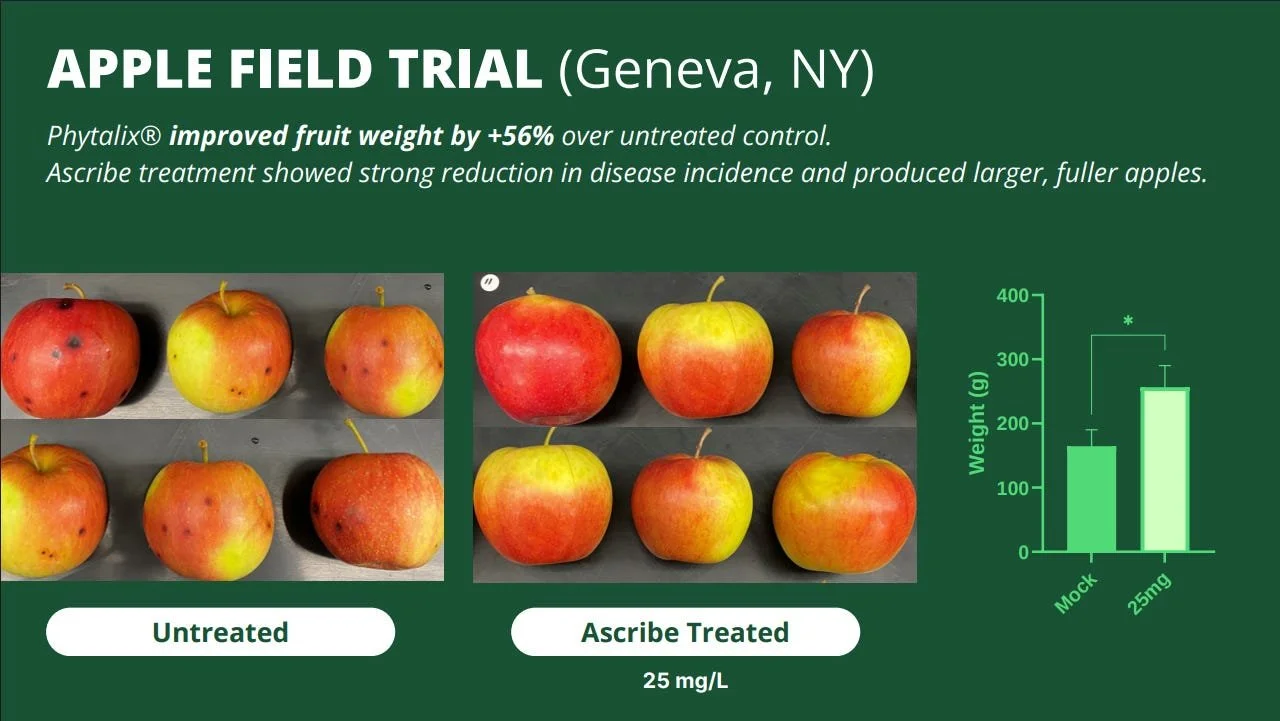
Ascribe held over 1,000 field trials across 20+ crops for their Phytalix® biofungicide. Phytalix delivers the efficacy and field economics of synthetic chemistry, while remaining nontoxic, biodegradable, and non-GMO. Here is the result of their application to apples in New York. Compared to the untreated apples, they showed a 56% increase in the fruit’s average weight and 79% less disease incidence.
Trailhead News
Find us at RFSI in Denver on October 7th - 9th. GP Mark Lewis is speaking on Wednesday about “Understanding Liquidity, Exit Opportunities, and Return Potential Across Investments in Regenerative” and we’re co-hosting an evening event with Mad Agriculture on Weds, October 7th. Message us if you’ll also be there!
Mark joined the Triple Helix Investment Council. The group brings together investors across capital types and stages to examine the dynamics shaping agricultural innovation. Mark joins members from Builders Vision, Breakthrough Energy, XPRIZE, Corteva, Bayer, and others.
Nick joined the industry advisory board of UGA’s Institute for Integrative Precision Agriculture. The institute is Georgia’s hub for digital farming innovation, convening 70+ faculty and 80+ graduate students across seven UGA colleges around next-generation technology in agriculture, food, and forestry.
Pete joined the Board of the Regenerative Organic Alliance. ROC certification is becoming the standard that serious regenerative claims get measured against, and, as you’ll read above, it’s the benchmark Edacious is now building around four years of nutritional data.
Mark was also featured by his alma mater, CU Boulder, in an inspiring look at how he found his way into this industry and co-founded Trailhead. These speaks to the passion behind how Trailhead came to be!
Portfolio Companies in the News
TerraBlaster just announced their $12.5M Seed round, with participation by our team at Trailhead, Khosla Ventures, Ulu Ventures (lead), Builders Vision, amongst others. The company continues to gain exponential awareness as they move into commercialization of their NASA founded laser sensors to detect precision soil nutrient composition.
Leaf raised a $13M Series B co-led by Leaps by Bayer. Leaf now processes data covering roughly 20% of global crop acres each year, and the largest input company in the world just bought into the data layer beneath its own products.
SWARM Engineering closed an oversubscribed $10M Series A, co-led by S2G and AgRogue, also with our participation (Q1’26 follow-on investment). One of SWARM’s customer case studies shows how SWARM cut planning cycles by 40%. Also notable is that Land O’Lakes’ Chief Strategy Officer joined SWARM’s advisory board, bringing enterprise strategy leadership and deep roots across the U.S. cooperative and agrifood ecosystem.
Local Line just opened enterprise-sized doors for its suppliers, announcing new sales channels that connect its farmer and food hub base directly to Chipotle, Sysco Marketplace, US Foods Direct, and GFS Endless Aisle. Think “Shopify + Amazon” for local food: suppliers opt into enterprise demand while keeping their own independent storefronts. This unlocks wholesale volume that was previously out of reach for most local producers... And on that note, Local Line also launched Square Sync earlier this quarter, letting farms and market vendors sell in person with Square and reconcile everything automatically in Local Line.
Avalo‘s first independent Life Cycle Assessment confirmed what they’ve been promising all along: their AI-bred, climate-adapted cotton delivered a 47% cut in GHG emissions, 71% less synthetic fertilizer, and 100% less irrigation water versus conventional cotton. Furthermore, every single first-year farmer partner returned and a sixfold acreage expansion planned for 2026. The market noticed: Advance Denim signed a multi-year deal as Avalo’s “founding mill partner” to bring low-footprint cotton into commercial denim, and Avalo’s genetics now anchor “Seed to System,” billed as the first AI-powered apparel manufacturing ecosystem.
CamoAg keeps stacking wins: Pivot Bio signed a multi-year agreement to deploy CamoAg’s geospatial intelligence platform. With visibility into 1M+ connected farming operations across 800M US acres, this will sharpen how their sales teams can find and engage growers. We can consider this a marquee agtech customer win beyond the Farm Credit channel.
Soiltech Wireless got a well-deserved victory lap in the press this quarter. Capital Press profiled the company’s expansion into university research stations and a three-product platform, while local coverage of Idaho’s conservation-district programs showed farmers using Soiltech sensors to cut overwatering, with University of Idaho Extension citing roughly 10% water-use reduction among participating irrigators. Third-party validation doesn’t get much better than a farmer keeping the sensor after the pilot ends.
Edacious helped Alexandre Family Farm become one of the first US dairies to carry verified omega-balance claims right on the packaging, backed by a year of monthly sampling across 60+ nutrient markers. They also teamed up with Community Food Works in the Hudson Valley to test wheat, flour, and bread across a real supply chain, helping push the conversation on farm economics from yield to nutritional quality.
Funga deepened its partnership with the Arbor Day Foundation to scale high-integrity carbon removals, pairing Funga’s soil-microbiome reforestation science with Arbor Day’s corporate buyer network. This is a meaningful commercial channel for one of our portfolio’s most distinctive science stories of mycorrhizal fungi reintegration into forestlands.
Mad Capital was profiled in GreenMoney Journal’s “The Capital Farmers Actually Need”, as the team now finances over 175,000 acres, most certified organic.
Crop Diagnostix is taking its RNA-based crop health early-warning system commercial, rolling out via ag retailers including CHS and Wilbur-Ellis after successful corn and potato trials. The system detects plant stress weeks before symptoms are visible with trial data pointing to a ~$720/acre net profit advantage.
Ascribe Bioscience, beyond the Syngenta partnership we shared last quarter, also announced a multi-year R&D collaboration with Corteva to evaluate PHYTALIX® technology as a seed treatment, extending the same non-toxic mode of action into the ~$11B seed-treatment market. Two of the largest crop protection companies in the world are now betting on Ascribe’s products.
Vence (Trailhead exited in 2022 in company sale to Merck Animal Health) was featured prominently in Deseret News’ feature on how virtual fencing is “removing fences across the West,” named among the four main US providers as ranchers adopt the technology for cost savings, wildlife corridors, and flexible grazing.
LandTrust CEO Nic De Castro made the podcast rounds, including a great Future of Agriculture episode on how farmers and ranchers can add recreation revenue “without the headaches.” This details why the diversified-income story that resonates in a relatively depressed ag economy.
White Leaf Provisions earned a top transparency rating in Consumer Reports’ review of baby food brands’ heavy-metals disclosures under California’s new AB 899 law. Consumer Reports specifically praised how easily consumers can find all of White Leaf’s test results. Radical transparency and utmost quality is absolutely part of their brand’s moat.
HowGood has integrated its database of 12M+ product carbon footprints into Sweep’s sustainability platform, giving food companies product-level emissions data for Scope 3 accounting and regulatory reporting. Ingredion is among the first major adopters.
TerraDot, which recently acquired our portfolio company Eion, just announced a new partnership with Google to be their largest carbon removal purchase to date, deploying climate solutions across 200,000+ hectares of Brazilian rice farms that aim to eliminate 1 million metric tons of CO₂e from methane by 2030 and permanently remove 1 million metric tons of CO₂ by 2040 through enhanced rock weathering.